

Why National EB-5 Chooses Texas for Project Development
20.10.2026
|News
TEXAS: WHY NATIONAL EB-5 CHOOSES ONE OF AMERICA’S MOST DYNAMIC GROWTH MARKETS
Texas is not only one of the largest economic centers in the United States but also a market offering favorable conditions for commercial real estate development and long-term immigration plans.
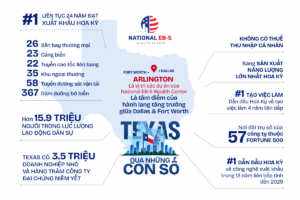
TEXAS BY THE NUMBERS
31.7M |
8.8% |
54 |
| Population in 2025 | Population growth since 2020 | Fortune 500 companies in 2025 |
When considering an EB-5 project, investors often pay close attention to capital structure, job creation potential, construction progress, and capital repayment strategies. However, there is another equally important fundamental factor: Where is the project being developed?
A real estate project does not exist in isolation. Its potential is closely tied to its location – population growth, economic strength, consumer demand, the ability to attract businesses, and the area’s long-term development prospects.
This is also one of the reasons why National EB-5 Wealth Center focuses on developing projects in Texas.
As the second most populous state in the United States, Texas offers a compelling combination of a large economy, continued population growth, a dynamic business environment, rapidly expanding metropolitan areas, and diverse opportunities in education, employment, and quality of life.
For EB-5 investors, Texas is therefore more than just a location for their investment. It may also be a destination worth considering as their families begin a new chapter in the United States.
01. Texas Continues to Attract New Residents

One of the clearest indicators of Texas’s appeal is its population growth.
According to the latest estimates from the U.S. Census Bureau, Texas’s population reached approximately 31.7 million in July 2025, making it the second most populous state in the United States, behind California.
More notably, compared with April 2020, the state’s population increased by approximately 8.8%, equivalent to more than 2.5 million additional residents.
Between 2024 and 2025 alone, Texas gained more than 391,000 residents – the largest absolute population increase among all 50 U.S. states.
Behind these figures is a significant market trend: as populations grow, demand for housing, shopping, dining, services, education, healthcare, and infrastructure also expands.
For commercial real estate, this represents one of the fundamental drivers of genuine market demand.
02. Beyond Population Growth – Texas Is Home to Thriving Metropolitan Areas
Texas’s growth is not concentrated in just one city.
The state is home to several major economic centers, including Houston, Dallas, Fort Worth, Austin, and San Antonio. According to the U.S. Census Bureau, Texas had five cities among the most populous in the United States in 2024: Houston, San Antonio, Dallas, Fort Worth, and Austin.

In particular, the Dallas–Fort Worth–Arlington metropolitan area – where National EB-5 has significant project development activities – continues to demonstrate remarkable expansion.
By 2025, the Dallas–Fort Worth–Arlington metropolitan area had reached approximately 8.5 million residents, an 11% increase compared with 2020. During the 2020–2025 period, approximately 270,000 residents moved to the area from other parts of the United States.
Fort Worth was also among the fastest-growing U.S. cities in 2025.
These figures highlight an important point: Texas’s growth is not limited to the state level. Development is occurring within metropolitan areas where demand for housing, commercial spaces, and services continues to expand.
03. One of America’s Major Economic and Business Centers
Texas has long been associated with the energy industry. However, today’s Texas economy extends far beyond oil and gas.
The state has developed a diversified economic ecosystem encompassing technology, manufacturing, finance, aviation, logistics, healthcare, real estate, and professional services.
In 2025, 54 Fortune 500 companies were headquartered in Texas. Of these, 26 were based in the Houston area and 21 in the Dallas–Fort Worth–Arlington region.
Texas also benefits from a strategic geographic position within the U.S. trade network. Bordering Mexico, the state has extensive infrastructure, including seaports, land border crossings, and some of the busiest airports in the country.
Together, these advantages create a mutually reinforcing cycle of development:
| 01 | Businesses establish operations | 02 | New jobs are created |
| 03 | More residents are attracted | 04 | Demand for housing, consumption, and services increases |
| Creating further opportunities for business and real estate development | |||
For commercial real estate projects, this provides a market foundation worthy of investors’ attention.
04. A Business Environment That Attracts Companies
One of the factors supporting Texas’s continued appeal to businesses is its tax policy and business environment.
Texas does not impose state or local personal income taxes. This is a notable distinction for employees, business owners, and families when compared with many other U.S. states.
Texas also continues to attract major corporations and corporate headquarters relocating to or expanding their operations within the state.
When a region maintains a favorable business environment, the impact extends beyond the number of companies operating there. It also generates demand for employees, offices, housing, retail spaces, restaurants, and various community services.
These real market needs are precisely what National EB-5 considers when evaluating locations for project development.
05. What Does Texas Offer Families Planning to Build a Life in the United States?
For EB-5 investors, the decision involves more than financial capital.
Behind an investment decision often lies a broader family plan: Where will the family live? What educational opportunities will their children have? What career and business opportunities are available? Is the cost of living suitable?
From this perspective, Texas offers several factors worth considering.
A Diverse Education System
Texas has an extensive education system, ranging from primary and secondary schools to higher education institutions.
According to information from the State of Texas, its public higher education system includes 7 public university systems, 37 four-year public universities, and 50 community college districts.
The state also has 16 Tier One research universities, along with numerous institutions offering programs in business, engineering, computer science, and biotechnology.
This is particularly meaningful for families who pursue EB-5 partly to provide their children with greater educational opportunities and long-term development prospects.
Diverse Housing Options and Living Environments
Texas covers a vast geographic area and offers a variety of urban environments, from major economic centers to rapidly developing suburban communities.
According to the U.S. Census Bureau, the median value of owner-occupied housing units in Texas during 2020–2024 was approximately $283,800, while the homeownership rate stood at approximately 62.6%.
Of course, housing costs vary significantly among Dallas, Houston, Austin, Arlington, and surrounding suburbs. However, Texas’s size and diversity provide families with a broad range of choices based on their budgets, employment, schools, and preferred lifestyles.
Career and Business Opportunities Across Multiple Industries
A diversified economy means that opportunities in Texas are not limited to a single industry.
From traditional and renewable energy to technology, manufacturing, healthcare, finance, logistics, aviation, and services, the presence of numerous economic sectors creates a relatively diverse employment and business environment.
For EB-5 families planning not only to settle in the United States but also to continue developing their careers or businesses, this is another factor worth considering.
06. Is Texas the “Perfect” Place to Live?
No state is ideal for everyone, and Texas is no exception.
Families considering relocation should evaluate practical factors such as hot summer weather, transportation differences between cities, commuting distances, local property taxes, insurance costs, and the cost of living in specific areas.
Importantly, the absence of a state personal income tax does not mean Texas residents pay no taxes. Property taxes are administered and collected locally, while the state sales tax rate is 6.25%, with combined state and local sales taxes potentially reaching 8.25%.
Therefore, any decision to relocate to Texas should be evaluated based on each family’s circumstances, financial situation, and long-term goals.
By examining Texas comprehensively – including both its advantages and practical considerations – we can better understand why the state continues to attract hundreds of thousands of new residents and numerous businesses each year.

07. Why Does National EB-5 Focus on Developing Projects in Texas?
For National EB-5 Wealth Center, the decision to focus on project development in Texas is not simply based on the state’s size.
What matters to us is genuine market demand.
As an area continues to welcome new residents, businesses expand their operations, and new residential communities emerge, demand for commercial real estate, retail establishments, restaurants, and everyday services also has a foundation for growth.
This is why National EB-5’s project portfolio focuses on Texas markets where our team can maintain direct oversight and a strong understanding of local market characteristics.
In the Arlington–Dallas/Fort Worth area, National EB-5 has developed and continues to develop projects such as Shops of Wintergreen II, The Landmark at Arlington, and Asia CityCentre.
Each project has its own structure, location, and characteristics. The results of previous projects do not guarantee the outcome of any future investment.
A common principle in National EB-5’s approach to the Texas market is prioritizing appropriately scaled projects that respond to genuine local demand and remain within the team’s capacity for direct development oversight.
08. Texas – Where Investment and Future Plans Can Come Together
For an EB-5 family, the location of an investment project and the place they ultimately choose to live do not necessarily have to be the same.
However, Texas presents an interesting intersection between these two considerations.
From an investment perspective, it is a market characterized by a large population, notable growth, a diversified economy, and continuously expanding metropolitan areas.
From a lifestyle perspective, Texas offers a wide range of options in education, careers, business, housing, and communities, accommodating different plans for families beginning a new life in the United States.
That is why, when National EB-5 chooses Texas, we look beyond the physical location where a project will be built.
We consider what is happening around the project: who is moving into the area, how communities are developing, where businesses are investing, and what new demands may emerge as the region continues to grow.
Because a real estate project can only have a solid foundation when it is supported by a market with genuine demand.
For National EB-5 Wealth Center, this is one of the key reasons Texas remains central to our long-term project development strategy.
Related Posts

19.09.2026
Events
RECAP | EB-5 Seminar: Investment Strategies for a Sustainable Future Ahead of the September 30, 2026 Milestone
RECAP | EB-5 SEMINAR: INVESTMENT STRATEGIES FOR A SUSTAINABLE FUTURE AHEAD OF THE SEPTEMBER 30, 2026 MILESTONE On July 11, 2026, at Mai House Saigon Hotel, National EB-5 Wealth Center successfully hosted the specialized seminar “EB-5 Investment Strategies for a Sustainable Future Ahead of the September 30, 2026 Milestone,” bringing together professionals in investment, legal […]

15.09.2026
News
Could U.S. Immigration Applications Move Online as USCIS Accelerates Digitalization?
COULD U.S. IMMIGRATION APPLICATIONS MOVE ONLINE AS USCIS ACCELERATES DIGITALIZATION? The U.S. immigration filing process is gradually evolving as U.S. Citizenship and Immigration Services (USCIS) continues to expand its electronic systems and services through the USCIS Online Account. USCIS online filing for eligible forms is becoming an increasingly notable part of the broader digitalization of […]

29.06.2026
Events
EB-5 Investment Strategy Seminar Before the September 30, 2026 Milestone
EB-5 Seminar hosted by National EB-5 Wealth Center on July 11, 2026, provides investors with the latest EB-5 investment strategies ahead of the September 30, 2026 milestone. An exclusive seminar providing updated insights on the EB-5 program, investment strategies, Adjustment of Status, Concurrent Filing, and long-term planning opportunities for Vietnamese investors. Event Introduction As the […]

14.10.2026
News
National EB-5 Wealth Center – Building Investor Trust
NATIONAL EB-5 WEALTH CENTER – BUILDING TRUST THROUGH HOW WE SELECT PROJECTS AND SUPPORT EVERY INVESTOR An EB-5 investment is more than a financial decision. For many families, it represents a long-term plan involving U.S. permanent residency, educational opportunities for their children, and new possibilities for the entire family. When exploring the EB-5 Immigrant Investor […]
Call us
+1-855-888-0099